MedicTests 2026 EMS Education
- 4.7
- Rating
- 50.00K
- Installs
- Free
- Price

 Analysis by App-foxy
I approached MedicTests 2026 EMS Education as a study companion rather than a general medical reference, and that distinction matters. This is an education app from MedicTests built around EMS training and test preparation, so its value depends on how deliberately you use it. I found it most useful when I had a defined topic to revise, a short block of time, and a willingness to review mistakes instead of simply chasing a higher score.
The app is free to install and aimed at everyone from a content-rating perspective, although its subject matter is clearly more relevant to EMS students, candidates preparing for certification exams, and working responders who want structured revision. It has attracted more than fifty thousand installs and holds a 4.7 average from roughly nine hundred ratings, which suggests that many learners find the format worthwhile. Those figures are encouraging, but they should not replace your own judgment about whether its study approach fits you.
How MedicTests 2026 feels in everyday study
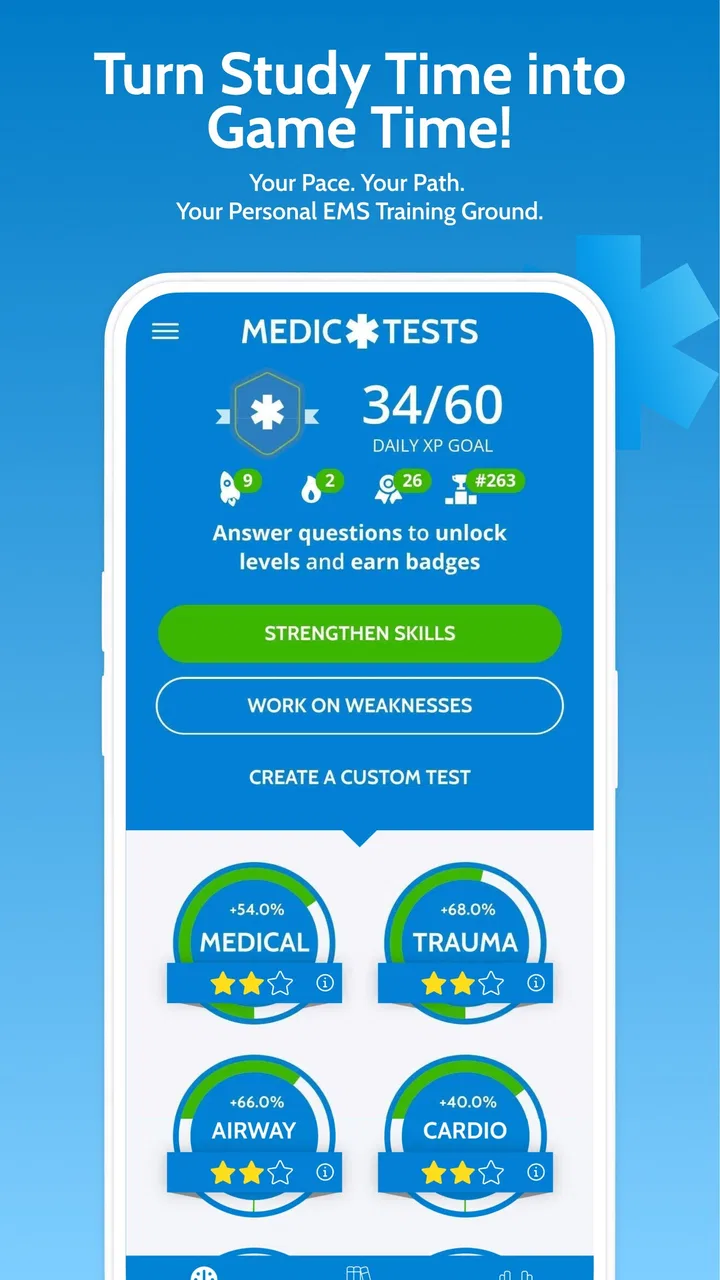
My first impression was that the app works best as a question-driven revision tool. Instead of asking me to read a long lesson from beginning to end, it encourages an active recall routine: answer a question, inspect the result, and decide whether the explanation exposes a genuine knowledge gap. That makes it easy to use during a commute, between classes, or during a short evening session when opening a large textbook feels like too much work.
You May Also Like

 Blood Strike: 2.5 Anniversary
Blood Strike’s Loadouts Turn Every Drop Into a Tactical Gamble
A close look at Blood Strike’s custom loadouts: how fast access to signature weapons reshapes its battle royale rhythm, rewards preparation, and narrows the gap between fights.

 Pandora - Music & Podcasts
Pandora’s Music Is Easy to Start, but Harder to Recover
Pandora’s strength is its low-effort path from a seed to a station. Its weak spot is how much confidence it asks you to place in connection, setup, and quiet recovery.

 8 Ball Pool
 Is Built on Rivalries, Rematches, and Routine
A close look at the rivalries, rematches, shared routines, and unanswered safety questions that turn a quick pool match into a persistent mobile community.

 Samsung Music
’s Quiet Strength Is Playing What You Already Own
Its reach comes less from spectacle than from dependable access to a personal library. That simplicity is both the app’s strongest retention engine and its ceiling.

 AccuWeather: Weather Radar
AccuWeather Review: A Quick, Clear Forecast for Everyday Decisions
For everyday plans, the best forecast is the one you can understand quickly. AccuWeather makes rain timing, radar, and local conditions easy to act on, with a few trade-offs.

 Hill Climb Racing
Why Hill Climb Racing Still Turns Crashes Into One More Run
A tiny car, a bumpy hill and one more upgrade: Hill Climb Racing keeps resurfacing because its simple chaos makes every near-miss feel personal.
More From Our News Desk
View All News


A realistic routine would be a student reviewing airway and patient-assessment material after class. I would begin with a small session, answer each item without looking anything up, and mark the questions that required guessing. Afterward, I would revisit those weak areas in my course notes and return to the app later. The important part is not treating the score as proof of readiness. A correct answer reached by luck needs almost as much attention as an incorrect one.
The short-description label, MedicTests 2026, gives the app a current exam-preparation focus, but I would still use it alongside the curriculum or exam outline that applies to my training. EMS education is not just a collection of isolated facts. It involves sequencing, judgment, communication, and safe action under pressure. A practice question can reinforce those ideas, but it cannot substitute for supervised practical work or instructor feedback.
A better way to use the question format
One of the less obvious strengths of this kind of app is that it can reveal uncertainty earlier than passive reading. When I read a chapter, familiar terminology can create the feeling that I understand it. When I must choose an answer, the weak point becomes visible. I recommend keeping a simple note with three columns: the topic, why my answer was wrong or uncertain, and what rule or distinction I need to remember.
That workflow prevents a common mistake: repeating the same quiz until the answers become familiar. Recognition is not the same as understanding. If I remember that a particular option was correct but cannot explain why, I treat the result as unfinished learning. The app is therefore strongest when it starts a review cycle rather than ending one.
I also found it sensible to separate quick practice from serious revision. A few questions can be useful when time is limited, while a longer session is better reserved for reviewing explanations and checking related material elsewhere. This makes the free entry point practical for casual exploration, but learners who want a complete study system will need discipline outside the app.
Who benefits most from it
MedicTests is a good match for learners who already have basic instruction and want regular practice. Students preparing for an EMS examination can use it to identify topics that deserve another pass. New responders may appreciate having a portable way to revisit terminology and decision-making concepts. Experienced users can also use short sessions to keep foundational material active, provided they do not mistake practice performance for a complete clinical assessment of their skills.
I would especially recommend it to someone who struggles to turn spare minutes into useful study time. A textbook often requires a desk, concentration, and a clear stopping point. A question app is easier to pick up and put down. That convenience can make a real difference during a busy training schedule, but only if the learner resists tapping through questions mechanically.
It is less suitable for a person starting from zero and expecting the app to teach every concept in a carefully ordered course. I would also hesitate to make it the main resource for someone who needs detailed diagrams, long-form explanations, or instructor-led case discussion. In those situations, a formal class, textbook, video lesson, or skills lab is the better primary option, with this app serving as reinforcement.
What the current version means for users
The current version is 11.3.2, and the app has been available since January 7, 2021. That history gives it the feel of an established study product rather than a brand-new experiment. For an existing user, the practical benefit of an established version is continuity: the app is being maintained as a recognizable preparation tool, so it makes sense to assess it as part of a longer study routine rather than as a one-time download.
I would be careful, however, about reading too much into a version number. A newer release can improve stability, presentation, or content handling without changing the fundamental way a learner studies. The evidence I can act on today is the current app experience and its continued availability, not a promise that future updates will add a particular module or transform it into a full course.
For someone returning after a break, the sensible approach is to begin with familiar topics and then test retention on areas that used to feel easy. Do not assume that previous progress equals current competence. EMS knowledge fades unevenly, and a short diagnostic session can show whether the problem is forgotten terminology, poor prioritization, or confusion between similar choices.
Free access, paid depth, and the real trade-off
The app is free, but it includes in-app purchases ranging from about thirty-five dollars to two hundred dollars per item. That makes the initial download low-risk, yet the full cost of using every paid option can be significant. I would not purchase anything immediately. First, I would check whether the free material matches my training level, whether the explanations are useful, and whether I can maintain a study habit with the format.
This pricing structure creates a clear trade-off. A focused learner may consider a paid package worthwhile if it replaces several smaller study purchases and fits a specific exam plan. Someone who only wants occasional general revision may find the higher-priced options difficult to justify. The right question is not whether the app is free to start, but whether the content I actually need is included in the part I am prepared to use.
I also recommend setting a purchase boundary before studying. Decide which exam or learning goal you are supporting, how long you expect to use the app, and what evidence would make an upgrade worthwhile. Without that plan, it is easy to buy more material simply because additional questions feel productive. More practice is not automatically better if the underlying misunderstanding remains unresolved.
Where it compares well with ordinary alternatives
Compared with a printed question bank, the app is more convenient for quick sessions and easier to carry between locations. Compared with rereading notes, it demands a response, which makes gaps harder to hide. Compared with a classroom, it is more flexible and private, but it cannot observe a practical skill or correct the way I perform an assessment. Compared with a broad medical reference app, it is more directly aligned with EMS test preparation rather than being a general encyclopedia.
That last comparison is important. If my goal is to look up a definition quickly, a reference source may be faster. If my goal is to develop hands-on confidence, supervised practice is essential. If my goal is to rehearse exam-style decisions repeatedly, MedicTests is the more natural fit. I see it as a middle layer between passive study material and formal instruction: active enough to expose weaknesses, but not complete enough to stand alone.
The app also has an advantage over a static question book when my schedule changes. I can use a short session on a busy day and a deeper review when time allows. The drawback is that a digital format can encourage speed. With a book, I am more likely to write notes in the margin; with an app, I need to create that reflection habit intentionally.
Limitations I would plan around
The central limitation is scope. Test questions can check recall and reasoning, but EMS competence also depends on communication, teamwork, scene awareness, equipment handling, and the ability to adapt when a patient does not match a neat question stem. I would never use a strong app score as permission to skip practical training or local guidance.
Another limitation is the risk of studying to the interface instead of studying the subject. If I repeatedly practice only the topics that feel comfortable, the results may look better while my overall preparation stays uneven. I would use a written checklist from my course or exam objectives to decide what to study, then use the app to test those areas rather than letting the most convenient questions dictate the entire plan.
There is also a personal-fit issue. Some learners need detailed explanations before they can answer confidently; others learn effectively through repeated testing. If I am in the first group, I would pair each session with a trusted textbook or instructor explanation. If I am in the second group, I would still slow down after mistakes and explain the reasoning aloud, because rapid repetition can produce shallow familiarity.
Because the app is rated for everyone, it is broadly accessible as a mobile education product, but that does not mean every learner will find the medical content equally appropriate without context. A beginner should have a structured source nearby, while a trained user should relate practice questions to current instruction and safe procedures. The age label describes accessibility, not professional readiness.
Practical study habits that make it stronger
My preferred method is a three-pass cycle. On the first pass, I answer honestly and avoid checking notes. On the second, I review every uncertain answer, including guesses that happened to be correct. On the third, I write one sentence explaining the principle behind the answer. This turns a quiz session into a compact lesson and gives me something useful to revisit later.
A second useful habit is to study by contrast. When two answer choices seem similar, I write down the distinction that separates them. EMS questions often become difficult not because every option is absurd, but because two choices appear reasonable until priority, timing, or patient presentation changes the decision. Practicing those contrasts is more useful than memorizing isolated phrases.
I would also avoid doing all sessions in the same environment. A quiet desk is good for careful review, while a short session away from home tests whether I can retrieve information without relying on a familiar routine. This is not a substitute for realistic simulation, but it does prevent my performance from depending entirely on one comfortable setting.
Finally, I would schedule occasional no-app checks. After several sessions, I would close the app and explain a topic from memory, sketch the order of an assessment, or discuss a scenario with a classmate. If I can answer multiple-choice questions but cannot explain the reasoning without prompts, I know I need broader study rather than another round of the same quiz.
What I would watch as the app evolves
For future use, I would pay attention to whether updates make the learning process clearer, not merely whether the version number changes. The most valuable improvements would be ones that help learners understand why an answer is right, identify recurring weak areas, and connect practice with a coherent study plan. Those are the details that determine whether an app remains useful after the novelty fades.
I would also watch how well the current 2026 focus stays aligned with the learner’s actual exam pathway. EMS education is not identical for every student, and a useful preparation tool needs to fit the level and objectives being studied. Until I know that alignment is right for me, I would treat the app as a supplement and verify important concepts through my course materials and instructors.
My overall view is positive but measured. MedicTests offers a convenient way to turn spare time into active EMS revision, and its strong average rating, broad install base, and free starting point make it easy to try. Its best use is focused practice with deliberate review. Its weakest use is passive tapping or treating a quiz score as proof of clinical ability.
I would recommend it to a learner who wants portable test preparation and is willing to build the surrounding study habits. I would skip it as a sole resource if I needed a complete beginner course, hands-on instruction, or a detailed reference library. Used in the right role, MedicTests 2026 EMS Education is a practical rehearsal tool, not a replacement for education itself.
FAQs for MedicTests 2026 EMS Education
01What is MedicTests 2026 EMS Education?
MedicTests 2026 EMS Education is a mobile study and exam-preparation app designed for people training in emergency medical services. It provides educational materials, practice questions, quizzes, and review tools intended to help users prepare for EMS-related assessments, including subjects commonly covered in EMT and paramedic education. It works best as a supplement to formal instruction, not as a replacement for an accredited course or instructor.
02Who can benefit from using MedicTests 2026 EMS Education?
The app may be useful for EMT and paramedic students, candidates preparing for certification or recertification exams, and practicing EMS professionals who want to refresh important concepts. Beginners can use it to become familiar with terminology and question formats, while experienced users may benefit from targeted revision. Your results will depend on your existing knowledge, study consistency, and the quality of your primary training resources.
03Does MedicTests 2026 EMS Education replace an official EMS course or textbook?
No. MedicTests 2026 EMS Education should be treated as a revision aid rather than a complete EMS education program. It cannot replace supervised practical training, clinical experience, official course materials, local protocols, or guidance from certified instructors. Emergency care practices and examination requirements can vary by location and organization, so users should always confirm information with current official sources before applying it in real situations.
04What topics and study features are available in the app?
The app focuses on exam-style EMS learning and may cover areas such as patient assessment, airway and breathing, trauma, medical emergencies, pharmacology, operations, and related emergency-care principles. Depending on the available version, users can typically work through practice questions, review explanations, monitor progress, and identify weaker subjects. Checking the current store listing is recommended because content and features may change with updates.
05Is MedicTests 2026 EMS Education free to download and use?
The download may be free, but some learning materials or advanced functions can require in-app purchases, a subscription, or account access. Before installing, review the app-store description, pricing details, renewal terms, and privacy information carefully. Also check whether an internet connection is needed for all features and whether progress is synchronized across devices. Availability, pricing, and included content may differ between Android and iOS.
Pros
- Covers key EMT topics in a focused
- exam-oriented format.
- Practice questions help reinforce recall between study sessions.
- Useful for reviewing terminology
- procedures
- and emergency care concepts.
- Compact lessons make it suitable for studying during short breaks.
- Can complement classroom instruction and hands-on EMS training.
Cons
- It should not replace accredited courses
- instructors
- or practical skills training.
- Some content may vary from current local EMS protocols and scope of practice.
- Advanced learners may find the question depth or explanations limited.
- Requires consistent self-study
- which may not suit every learning style.
- Medical education apps may need updates as guidelines and exam standards change.

MedicTests 2026 EMS Education
Gallery